

What a Demand Charge Is
A demand charge on an electricity bill is a fee based on the highest rate at which a facility draws power from the grid during a billing period. Unlike energy charges, which depend on the total electricity consumed over time in kilowatt hours, demand charges are based on peak power demand measured in kilowatts.
A demand charge does not price the electricity a facility uses. It prices the capacity the system has to hold ready to serve that facility's highest moment. The energy charge answers how much was consumed over the month, in kilowatt hours. The demand charge answers how much the grid had to be built to deliver at once, in kilowatts.
Utilities include demand charges to recover part of the cost of maintaining electrical infrastructure capable of serving a customer's maximum load. Substations, transformers, feeders, and other distribution equipment must be sized to deliver the highest level of power a facility might require at any moment, even if that level is reached only briefly.
Because this infrastructure must always be available, commercial customers are billed not only for the electricity they consume but also for the maximum power level their operations require during the billing cycle.
How Utilities Calculate Demand Charges
Demand charges are calculated using interval demand measurements recorded by the electric meter. Most commercial meters measure average power demand over 15 minute intervals.
At the end of the billing cycle, the utility identifies the interval with the highest average demand and uses that value as the billing demand.
The basic calculation is:
Demand Charge = Peak Interval Demand (kW) x Demand Rate ($ per kW)
In many tariffs, customers served at primary voltage may face lower demand rates than customers served at secondary voltage because primary service customers require less distribution infrastructure and fewer transformation stages. That discount is not free, and whether the trade is worth taking is a real decision for a growing account: see is ComEd primary voltage service worth it.
The determinant also varies by utility, and it varies more than most owners expect. Two questions decide most of the economics: which hours are eligible to set the charge, and whether a prior month's peak carries forward. The ComEd window is on this page. The downstate version is worked through for Ameren Illinois.
If you are on ComEd, you can skip the arithmetic: our demand charge calculator applies the exact rate for your delivery class from ComEd's tariff, including the per-rider rounding a simple multiplication misses.
Why a Single Peak Can Set the Monthly Demand Charge
To understand how demand charges work in practice, it helps to follow the trail from the utility bill back to the underlying meter data. A commercial electricity bill reports a single billed demand value, and that one number sets the demand charge for the entire billing period. The rest of the analysis involves identifying where that value came from in the facility's interval meter data.
Electric utilities determine demand charges using interval meters that record the facility's load throughout the billing cycle. Examining the interval data locates the exact moment the facility reached its highest recorded demand during the billing period. That single interval becomes the data point used to determine the billing demand.
Plotted across the full billing period, the pattern becomes clear. The facility operates with a repeating daily load cycle, but one short spike rises above the rest of the load profile. Demand charges are determined by this peak interval rather than the average load across the month. Even though the facility spends most of its time operating at much lower levels, that brief spike establishes the demand level used to calculate the monthly demand charge.
You don't pay for how much electricity you use. You pay for the single moment you use the most.
A Reconciled Demand Charge
A worked example makes the trail concrete. A single meter commercial site on ComEd's Small Load class was billed for 22.92 kilowatts of demand in one fall billing period. Reconstructed from the site's thirty minute interval data, the highest on-peak interval measured 22.92 kilowatts, matching the billed demand exactly, and it fell at 5:30 PM, inside the 9:00 AM to 6:00 PM window. The recomputed distribution demand charge came to within a few cents of the bill. No off-peak interval in the period rose above it, so the billed demand and the physical peak of the period were the same moment. This is the ordinary case: one interval, located in the data, reconciled against the bill.
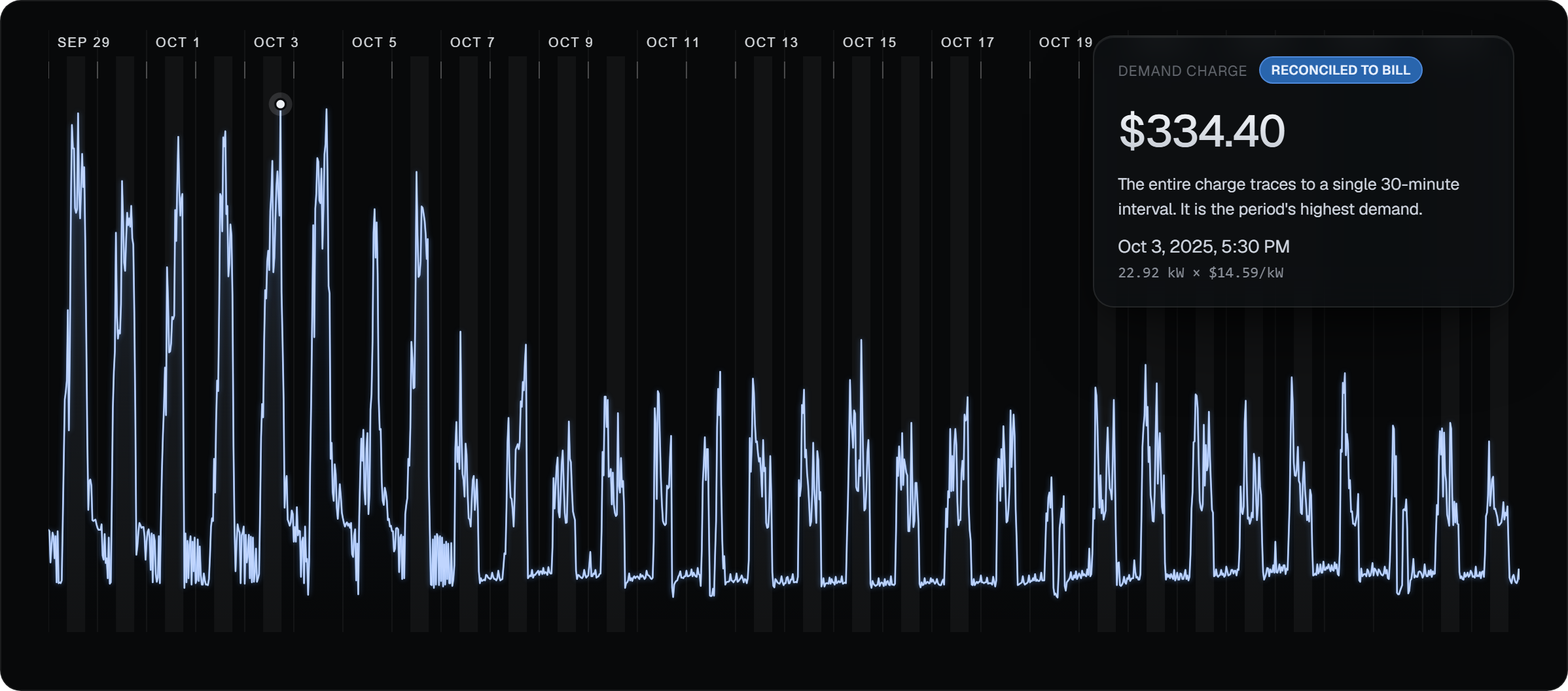
The free demand charge tool runs this reconstruction on any ComEd commercial account and shows the exact interval that set the charge.
When the Physical Peak Isn't the Billed Peak
The clean case above, where the physical peak and the billed peak are the same interval, is not the only one. Sometimes the highest level the meter records is not the level that sets the charge.
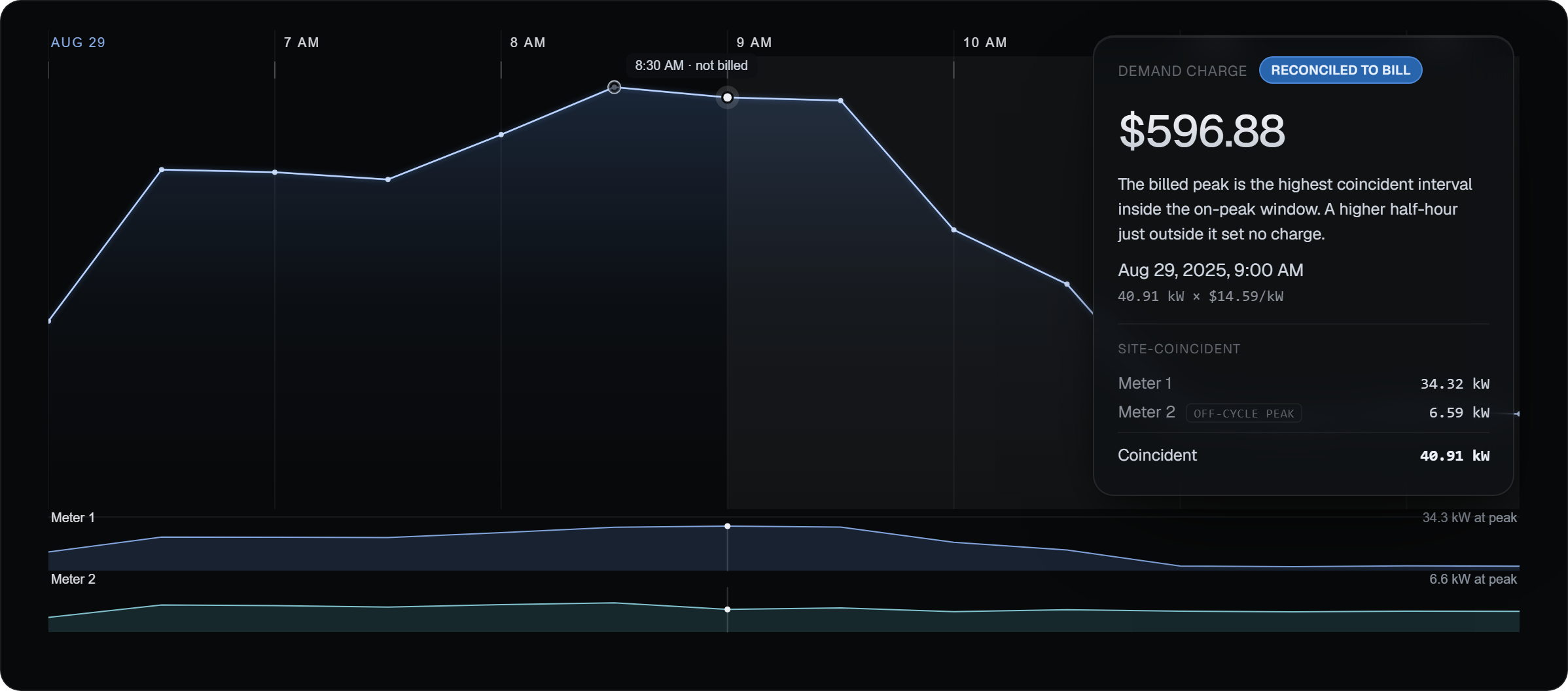
A two meter commercial site on ComEd's Small Load delivery class drew a site coincident peak of 40.91 kilowatts during one summer billing period. That value, measured across both meters at the same thirty minute interval, matched the billed demand on the delivery portion of the bill exactly, and it produced a Distribution Facilities Charge of $596.88 for the month.
The interval that set the charge began at 9:00 AM. Thirty minutes earlier, at 8:30 AM, the same site had drawn 41.94 kilowatts, a materially higher level of demand. That earlier interval was not billed, because ComEd measures billable demand only during the on-peak window of 9:00 AM to 6:00 PM on weekdays. The physical peak of the day sat just outside the window. The billed peak was the first qualifying interval inside it.
This is what makes demand charges difficult to reason about from the bill alone. The billed number is not the highest level the meter recorded. It is the highest level recorded inside a specific tariff defined window, reconciled against the bill. Reading it back requires the interval meter data and the tariff rule examined together.
How often that happens depends on the business. Across six ComEd meters and three years, the demand charge missed the real peak in 69 of 214 months, almost all of them at an evening or weekend business.
What Produced the Billed Interval
Once the billed demand value is identified, the next step is determining what produced the peak demand interval that set the charge.
If a true coincident peak occurred, one or more intervals in the meter data will show demand materially higher than the facility's typical operating level. This indicates that equipment loads overlapped or ramped simultaneously during a short period of time.
If tariff rules are dominant, the billed demand may correspond to defined peak windows or seasonal demand definitions rather than to unusual facility behavior. In these cases the charge reflects how the tariff defines billable demand rather than an isolated operational event.
If interval aggregation is involved, short duration spikes may be partially hidden within the meter's recording interval. Demand may appear relatively stable in averaged data even though brief spikes occurred inside the measurement window.
Distinguishing between these explanations requires three pieces of information: the billed demand value, the interval definition used by the tariff, and the interval level demand data recorded by the meter. Once those elements are examined together, the source of the demand charge can usually be traced to the specific interval that established the peak demand for the billing cycle. For worked examples, we traced that interval on six real ComEd commercial bills, reconciled to the meter.
Where Demand Charges Appear on a Commercial Electricity Bill
Demand charges typically appear in the delivery or distribution section of a commercial electricity bill. They are usually listed as a separate line item showing the billing demand in kilowatts, the demand rate in dollars per kilowatt, and the resulting charge.
Common labels include demand charge, billing demand, peak demand, or distribution demand.
Why Demand Charges Are Often Higher Than Expected
Demand charges often surprise facility operators because they are driven by short operational events rather than total energy usage. When multiple systems operate simultaneously, their combined load can produce a peak demand significantly higher than normal operating levels.
Without access to interval meter data, many businesses cannot easily identify when these peaks occur. As a result, a short spike lasting only a few minutes can determine a large portion of the monthly electricity bill.
How is demand charge calculated on an electricity bill?
Utilities calculate demand charges by measuring the highest average power draw recorded during a short interval within the billing cycle. Most commercial meters measure demand in 15 minute intervals.
During each interval, the meter calculates the average kilowatt load. At the end of the billing period, the utility identifies the interval with the highest demand and uses that value as the billing demand.
The calculation is typically:
Demand Charge = Peak Demand (kW) x Demand Rate ($ per kW)
For example, if a facility reaches a peak demand of 120 kW and the tariff demand rate is $18 per kW, the demand charge would be:
120 x 18 = $2,160
Some tariffs also include demand ratchets or coincident peak mechanisms that can increase the billed demand based on historical or system peak demand conditions.
Why are demand charges so expensive for businesses?
Demand charges are expensive because they recover the cost of infrastructure that must be sized for peak load rather than total energy usage. Utilities must maintain transformers, feeders, substations, and generation capacity capable of delivering the highest power level a customer might require at any moment.
Commercial and industrial facilities often operate equipment that draws large amounts of power for short periods. Examples include compressors, industrial motors, HVAC systems, ovens, or production machinery. When several pieces of equipment operate simultaneously, they can create short spikes in load that establish the billing demand.
Because the demand charge is based on the single highest interval during the billing cycle, even a brief spike can determine the charge for the entire month. This makes demand costs highly sensitive to operational timing rather than total electricity consumption.
Do residential electricity bills include demand charges?
Most residential electricity tariffs do not include demand charges. Residential customers are typically billed only for energy consumption measured in kilowatt hours.
Demand charges are primarily applied to commercial and industrial customers because their loads are large enough to affect grid capacity planning and infrastructure sizing.
However, some utilities have begun testing residential demand tariffs, particularly in areas with high adoption of electric vehicles, electric heating, or distributed energy resources. These tariffs attempt to manage peak grid demand by charging households based on their highest short interval power usage.
References
Referenced by
- 01Is the Demand Charge on Your Ameren Illinois Business Bill Worth Attacking?
- 02Can You Get Interval Data From Ameren Illinois, and Do You Need It?
- 03Does Ameren Illinois Have Peak Hours, and Do They Cost Your Business Anything?
- 04Ameren Illinois or ComEd: Does a Quote for One Site Transfer to the Other?
- 05ComEd Price to Compare: Is a Supplier Offer Cheaper for Your Business?
- 06ComEd Capacity Charge: Is It Worth Fighting on a Business Bill?
- 07The ComEd Capacity Charge on Hourly Pricing: What It Is, Why It Rose, and What It Does to the Worth-It Math
- 08ComEd Commercial Rates: What You Actually Pay
- 09Your ComEd Delivery Charge Became Several Lines in 2026. Did the Price Actually Change?
- 10Which ComEd Delivery Class Is Your Business In, and Is It Worth Staying Under a Threshold?
- 11Does ComEd Ratchet Your Demand Charge? What One Bad Month Actually Costs
- 12ComEd Demand Charges, Reconciled to the Meter
- 13The ComEd Distribution Facilities Charge, Explained
- 14The Energy Efficiency Programs Line on a ComEd Bill, and Who Can Opt Out
- 15Why Summer Afternoons Decide Your ComEd Hourly Pricing Bill
- 16ComEd Interconnection: Will Your Commercial Solar Project Clear It?
- 17Who Pays to Extend ComEd's Lines to Your New Site?
- 18Can You Move Your Peak Outside ComEd's 9-to-6 Window, and What Would It Save?
- 19Two Meters on One ComEd Site: Which Peak Actually Gets Billed?
- 20ComEd Nonresidential Delivery Service Charges by Delivery Class, 2024 to 2027
- 21Is ComEd Primary Voltage Service Worth It for Your Business?
- 22Should Your Business Take ComEd's Hourly Supply, Rate BESH, Instead of a Fixed Rate?
- 23Does Your Solar or Battery Need ComEd Rider POG?
- 24Is ComEd's Rider SPWS Storage Rebate Worth Sizing a Battery Around?
- 25Should Your Business Sign Up for ComEd Rider VLR When the Tariff Names No Price?
- 26ComEd Price to Compare: The Current Supply Rate and Every Posted Month Since 2017
- 27Illinois Commercial Solar Payback Calculator: Incentives, Honestly Stacked
- 28ComEd Demand Charge Calculator: Your Exact Distribution Charge
- 29How Often the Demand Charge Misses a Business's Real Peak: Six ComEd Meters, Three Years
- 30The Demand Charge Nearly Doubled While Usage Fell: A Distillery, Month by Month
- 31Do You Need ComEd Interval Data, or Does Your Bill Already Answer It?
- 32Does a Commercial Battery Pencil in Illinois?
- 33Electric Bill Calculator: Estimate Your Whole Bill, Not Just the Rate
- 34Why Is My Electricity Delivery Charge So High?
- 35Delivery vs Supply Charges on an Electricity Bill: Which Half Is Which, and Which One You Can Change
- 36How ComEd's Commercial Tariff Is Structured: Rate RDS and Its Three Charges
- 37Green Button Data: What It Is and How to Read Your Own
- 38How to Read a ComEd Commercial Electricity Bill: kW, kWh and Demand
- 39How to Reduce My ComEd Bill
- 40Illinois Commercial Battery Incentives, Honestly Explained
- 41Illinois Shines and Net Metering: Which Commercial Solar Incentives Pay?
- 42Illinois Shines and Your Battery: the Choice That Decides Whether You Can Charge From the Grid
- 43Illinois Virtual Power Plant: How Businesses Get Paid, and the Catch
- 44Interval Meter Data Analysis: Read Your Own File Free
- 45Is ComEd a Monopoly? Half of Your Bill Is, and the Bill Shows You Which Half
- 46kWh Cost Calculator: What You Actually Pay Per kWh
- 47Load Factor by Building Type: Worked Examples
- 48Electrical Load Factor: Formula and How to Calculate Yours
- 49Load Factor vs Demand Charge: What the Ratio Does to Your Delivery Cost
- 50What is Peak Demand?
- 51How to Reduce a ComEd Demand Charge Inside the 9-to-6 Weekday Window
- 52Your ComEd Business Bill Jumped. Which of the Four Causes Was It?
- 53Your Ameren Illinois Bill Is High. Which Part of It Actually Moved?