

What Is Peak Demand in Electricity
Peak demand in electricity is the highest level of power a building draws from the electrical grid during a short measurement interval within a billing cycle. Utilities measure this demand in kilowatts (kW), which represents the rate at which electricity is being used at a given moment.
Unlike total electricity consumption, which is measured in kilowatt hours (kWh), peak demand reflects how quickly electricity is used during a specific period of time. Even a building with relatively low overall energy use can create a high peak demand if large equipment operates simultaneously.
Because electrical infrastructure must be built to handle these short periods of high load, peak demand in electricity plays a central role in how commercial electricity bills are calculated.
How Utilities Measure Peak Demand
Utilities measure peak demand from the interval meter data that smart meters record in short time intervals. Most commercial meters store this data every 15 or 30 minutes.
For each interval, the meter calculates the average demand in kilowatts based on the energy used during that period. Over the course of a month, hundreds of these intervals are recorded.
At the end of the billing cycle, the utility identifies the highest interval demand recorded. This value becomes the building's peak demand for the billing period.
How Do You Get Peak Demand in kW from kWh on Your Bill?
You cannot calculate peak demand from kWh. There is no arithmetic that gets you there, and anyone who offers you a rule of thumb is guessing. kWh is a total, added up across the whole billing period. Peak demand is an instant, the single highest interval in that period. A total cannot tell you what its largest moment was.
What you can calculate, if you already have both numbers, is load factor:
total kWh / (peak kW x hours in the period)
The result describes how efficiently your site uses the capacity your peak interval set. If you set a high peak but draw a small amount most of the time, load factor comes out low. If you run steadily near your peak, it comes out high.
Note what that formula needs: it needs peak kW, which is the number you came here without. On a commercial bill you already have both, because the kW sits next to the demand charge and the kWh sits in the supply section. So load factor is computable from a commercial bill today.
On a residential bill neither number is usually there, and that is the practical test: if the only unit on your bill is kWh, you are almost certainly billed on energy alone and have no demand charge. If you see kW, you are billed for both how much you used and how fast you used it.
One caveat, because it decides whether the rest of this applies to you. That test holds for ComEd and for most utilities, but it is not universal. A few utilities, notably SRP and APS in Arizona, do bill residential demand charges. The units printed on your own bill are the authority, not the general rule.
What Is Peak Demand Measured In?
Peak demand is measured in kilowatts, because it measures how much power the utility has to be capable of delivering to your site at any given moment.
Some sites cruise along at 4 kW for ninety percent of the month, and spend the other ten percent at 60 kW. A distillery is a good example: it runs a still infrequently, which creates a 60 kW draw for six to eight hours before the site returns to 4 kW.
Because that run lasts hours, it covers full 30 minute intervals, so the whole 60 kW is billed. Since the utility must be ready to deliver 60 kW at any moment without notice, the site pays for 60 kW. At $14.59 per kW, the rate we reconciled to the cent on a real ComEd Small Load bill at secondary voltage, that is 60 kW x $14.59 = $875.40 in demand charges for the month.
Is Peak Demand Measured Over 15 Minutes or 30?
That depends on your utility. Meters commonly record at either 15 or 30 minute intervals, and the tariff decides which one is billed.
For ComEd, it is the highest 30 minute interval. That is not an inference; it is the definition of Maximum Kilowatts Delivered in ComEd's filed General Terms and Conditions, which also restricts it to 9:00 AM through 6:00 PM Monday through Friday, excluding the six holidays the tariff names.
The interval length is not a technicality. It is the charge. A 60 kW spike that lasts four minutes inside a 30 minute window does not set a 60 kW demand, because the meter records the average across the whole interval, not the highest instant inside it. The distillery above is the other case: a run that lasts hours covers whole intervals, so its full 60 kW bills.
How to Find Your Own Building's Peak Demand
Look at the kW value printed next to the demand charge on your bill. That is your billed peak demand for the period.
What the bill cannot tell you is the exact interval that set it, or the shape of the load that produced it. Two sites with identical monthly totals can pay very different demand charges depending on when their peak landed. For that you need the interval data behind the bill.
Peak Demand and Average Demand Are Not the Same Thing
Average demand is the total energy spread evenly across the period. Peak demand is the single highest interval. The ratio between them is load factor.
Take the distillery above. Four kW for ninety percent of a 730 hour month plus 60 kW for the other ten percent is about 7,008 kWh, an average of roughly 9.6 kW, against a billed demand of 60 kW. That is a load factor of about 16 percent.
At a site shaped like that, shifting or shaving the peak is likely to be more impactful than reducing total usage, because the demand charge is built on an instant rather than on the total. Whether that is true of your site is a question about your own load, answerable from your interval data rather than from this page.
How Do Demand and Peak Demand Differ on an Electric Bill?
On the bill they are two different printed numbers, and the gap between them is the tariff's billing window. Demand, or billed demand, is the kilowatt figure the demand charge line actually multiplies. Peak demand is the highest interval the meter recorded, whenever it happened. Where the two agree, the peak fell inside the window the tariff counts. Where they differ, it did not.
A reconciled ComEd Small Load bill shows exactly how they print. The account had two meters, and the bill listed each meter's reading at the site's on-peak maximum and at its off-peak maximum:
| On Pk kW | Off Pk kW | |
|---|---|---|
| meter 1 | 34.32 | 33.42 |
| meter 2 | 6.59 | 8.52 |
| site | 40.91 | 41.94 |
The site's peak demand for the period was 41.94 kW. The demand charge was billed on 40.91 kW, the on-peak figure, because ComEd's filed definition counts only the highest thirty minute interval between 9:00 AM and 6:00 PM on weekdays. The 41.94 came at 8:30 AM, before the window opened, and set nothing. The Distribution Facilities Charge line read 40.91 kW times $14.59, $596.88, reconciled to the cent from the interval data. So on that bill, demand and peak demand differed by 1.03 kW and thirty minutes, and only one of them cost anything.
A residential ComEd bill has neither number. Its Distribution Facilities Charge is billed per kilowatt hour, 6.333 cents on a June 2026 bill we reconciled, so there is no demand line to read, and the units on the bill are the test: kWh only means energy billing, a kW figure next to a delivery line means demand billing.
What Is the Difference Between Peak Demand and Maximum Demand?
In most utility tariffs there is no difference. Peak demand and maximum demand are two names for the same measurement, the highest average demand recorded in any single interval during the billing period, and a bill that prints one term is reporting the same kind of number as a bill that prints the other.
The distinction that actually matters sits elsewhere: between the maximum the meter recorded and the demand the tariff bills. Those are routinely different numbers, and three things separate them.
The billing window. Many tariffs count only part of the clock. On ComEd's standard commercial delivery classes, billed demand is the highest thirty minute interval between nine in the morning and six in the evening on weekdays. A facility's true maximum can occur at eight in the evening, be the largest reading of the entire month, and set nothing at all. The maximum is what the meter saw. The billed demand is what the tariff was watching.
Coincidence across meters. On a site with more than one meter, each meter has its own maximum, and adding those maxima together produces a number the site never drew. ComEd bills the site coincident peak, the highest combined draw across the meters at the same instant. In the reconciled example below, that distinction is the difference between a defensible 242.57 kW and an inflated figure assembled from four separate maxima, which is worth understanding on its own if your account carries more than one meter.
Interval average versus instantaneous. In engineering use, maximum demand sometimes means the instantaneous kilowatts a load draws, the sort of figure a clamp meter or a connected load calculation reports. Billed demand is never instantaneous. It is an average over a fifteen or thirty minute window, so a motor's inrush is a real maximum that the demand charge cannot see. Two people can look at the same building and disagree by a wide margin because one means the instant and the other means the interval.
A fourth divergence exists on some tariffs, though not on ComEd's standard commercial classes: a ratchet, under which billed demand is a fraction of a peak set in an earlier month and is therefore not this month's maximum by any definition.
The rule that follows is simple. When one of these numbers is being used to price something, ask which one it is. Where money is involved, the definition in the tariff beats the definition in the dictionary.
How Demand Charges are Calculated
Demand charges are calculated using the building's peak demand and the demand rate defined in the utility tariff.
Meters determine demand using what is often referred to as the peak demand formula:
Peak Demand (kW) = Energy Used During Interval (kWh) / Interval Length (hours)
During each measurement interval, the meter converts energy usage into an average demand value in kilowatts. The highest demand interval recorded during the billing cycle becomes the building's peak demand.
The demand charge on the electric bill is then calculated using:
Demand Charge = Peak Demand (kW) x Demand Rate ($ per kW)
Because this calculation is based on the highest interval rather than total monthly consumption, even a short spike in electricity use can significantly increase a building's demand charges.
For ComEd accounts, our demand charge calculator does this exactly: enter your peak kW and delivery class and it returns the Distribution Facilities charge straight from ComEd's tariff, the same ratebook we reconcile real bills to.
Both of those inputs are printed on the bill, and most owners do not know their delivery class offhand. If that is you, upload the PDF to the free ComEd bill reader instead. It reads the peak kW and works out the class by reconciling the demand line to the filed ratebook, which is a better answer than a guess.
The grid no longer prices electricity by how much you use, but by when you use it.
How a Peak Demand Spike Sets the Charge
Because utilities bill on the single highest interval, a short spike can set the charge even when total energy use is modest. A peak like this often forms when a large load, such as an air compressor, runs continuously or overlaps with other equipment inside one interval. For most of the billing period the building may draw only a fraction of that, yet the one window is what the demand charge is built on.
How far that peak sits above the building's average draw is its load factor, the total kWh divided by the peak kW times the hours in the period. A low load factor means a short spike is carrying a large share of the delivery cost; a high one means the peak is close to how the building runs all month.
Rather than illustrate this with invented numbers, the section below reconstructs a real one, measured from the meter and reconciled to the bill to the cent.
Which hour the spike lands in is a property of the business: measured across six ComEd meters, the monthly peak most often fell at 9 AM for an auto shop, 1 PM for a print shop and 7 PM for a bowling alley, and whether the tariff window billed it varied from never to 77 percent of months.
A Reconciled Peak, Measured Across Four Meters
Peak demand becomes concrete when it is reconciled against a real bill. One commercial site metered on four separate meters was billed for a demand of 242.57 kilowatts in a mid summer period. Reconstructing that figure from the interval data required summing all four meters at each thirty minute interval, because ComEd bills the site coincident peak, the highest combined draw across the meters at the same instant, rather than the sum of each meter's own separate maximum.
The measured site coincident peak came to 242.568 kilowatts, matching the billed demand, and the recomputed demand charge equaled the bill to the cent. The peak fell at 2:00 PM, inside the on-peak window, and was also the highest interval of the whole period.
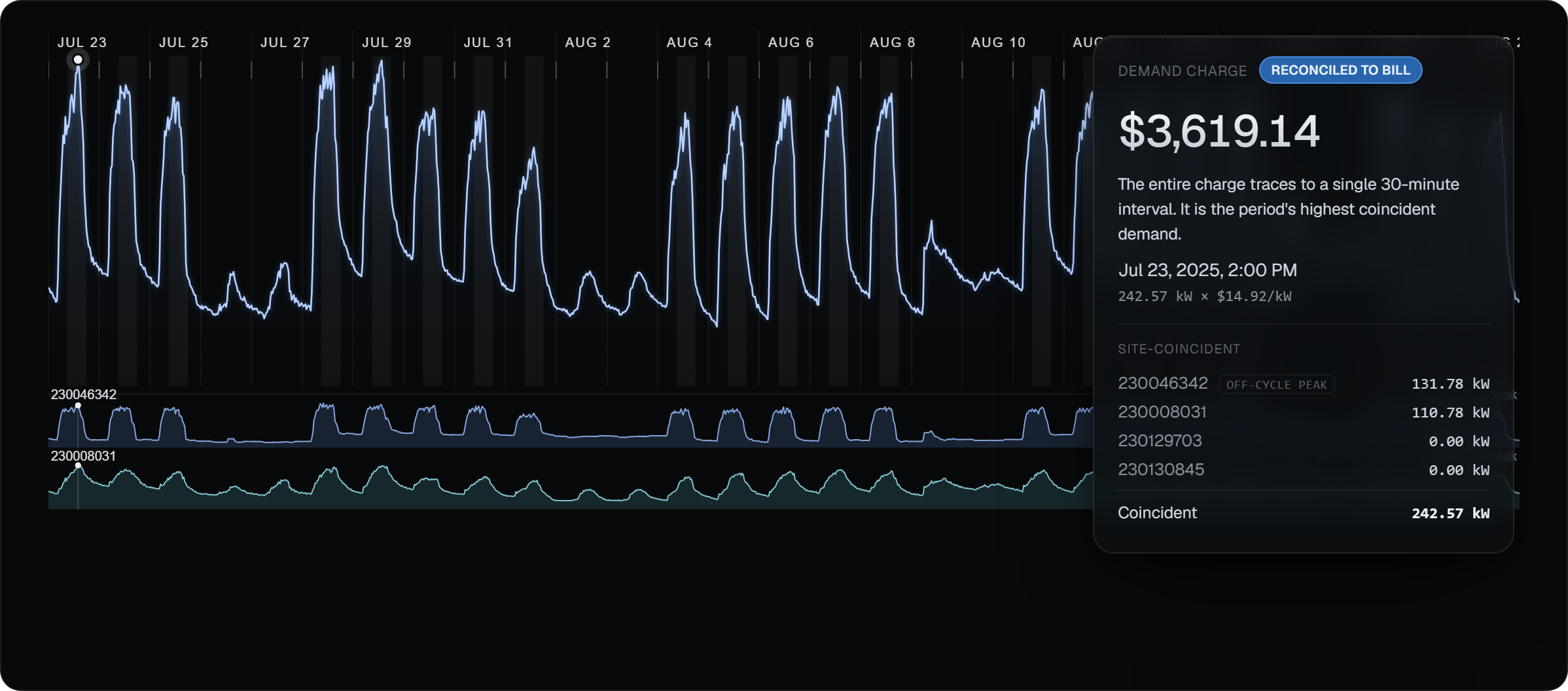
The same reconstruction runs on any ComEd commercial account with the free demand charge tool, which reads your interval data and shows the exact interval that set the charge, reconciled to the bill.
The coincidence rule is worth understanding on its own if your account carries more than one meter, because the per-meter numbers printed on the bill are not each meter's maximum and adding them up overstates your peak: which peak actually gets billed on a multi-meter ComEd site.
Why a Low-Energy Site Can Still Face a Large Demand Charge
In the reconciled example above, the site used only a modest amount of total energy, yet the delivery side of the bill still carried a demand charge far larger than that energy use would suggest, because demand and energy are measured differently. Supply is billed on the kilowatt hours you consume; the demand charge is billed on the single highest rate at which you drew power. A facility can be frugal over the month and still set an expensive peak in one interval, which is why the demand charge so often surprises.
References
Referenced by
- 01Is the Demand Charge on Your Ameren Illinois Business Bill Worth Attacking?
- 02Does Ameren Illinois Have Peak Hours, and Do They Cost Your Business Anything?
- 03ComEd Capacity Charge: Is It Worth Fighting on a Business Bill?
- 04The ComEd Capacity Charge on Hourly Pricing: What It Is, Why It Rose, and What It Does to the Worth-It Math
- 05ComEd Commercial Rates: What You Actually Pay
- 06Which ComEd Delivery Class Is Your Business In, and Is It Worth Staying Under a Threshold?
- 07Does ComEd Ratchet Your Demand Charge? What One Bad Month Actually Costs
- 08ComEd Demand Charges, Reconciled to the Meter
- 09The ComEd Distribution Facilities Charge, Explained
- 10ComEd Real-Time Pricing: Which Hourly Price Do You Actually Pay?
- 11ComEd Live Prices: The Last 24 Hours, Every Five Minutes
- 12Why Summer Afternoons Decide Your ComEd Hourly Pricing Bill
- 13ComEd Hourly Pricing vs the Flat Rate: Which Homes Actually Save
- 14Is ComEd Hourly Pricing Worth It? What Actually Decides It
- 15ComEd Interconnection: Will Your Commercial Solar Project Clear It?
- 16Who Pays to Extend ComEd's Lines to Your New Site?
- 17Can You Move Your Peak Outside ComEd's 9-to-6 Window, and What Would It Save?
- 18Two Meters on One ComEd Site: Which Peak Actually Gets Billed?
- 19ComEd Nonresidential Delivery Service Charges by Delivery Class, 2024 to 2027
- 20Is ComEd's Peak Time Rebate Worth Changing Your Afternoon For?
- 21Your Electricity Supplier Pays ComEd for Your Interval Data. Should You Pull It Yourself?
- 22Is ComEd's Rider SPWS Storage Rebate Worth Sizing a Battery Around?
- 23Should Your Business Sign Up for ComEd Rider VLR When the Tariff Names No Price?
- 24ComEd Supply Price and Wholesale Energy Cost, Month by Month, June 2025 to August 2026
- 25ComEd Price to Compare: The Current Supply Rate and Every Posted Month Since 2017
- 26ComEd Demand Charge Calculator: Your Exact Distribution Charge
- 27How Often the Demand Charge Misses a Business's Real Peak: Six ComEd Meters, Three Years
- 28The Demand Charge Nearly Doubled While Usage Fell: A Distillery, Month by Month
- 29Do You Need ComEd Interval Data, or Does Your Bill Already Answer It?
- 30Does a Commercial Battery Pencil in Illinois?
- 31Electric Bill Calculator: Estimate Your Whole Bill, Not Just the Rate
- 32Why Is My Electricity Delivery Charge So High?
- 33How ComEd's Commercial Tariff Is Structured: Rate RDS and Its Three Charges
- 34Green Button Data: What It Is and How to Read Your Own
- 35How to Read a ComEd Commercial Electricity Bill: kW, kWh and Demand
- 36Illinois Commercial Battery Incentives, Honestly Explained
- 37Illinois Shines and Your Battery: the Choice That Decides Whether You Can Charge From the Grid
- 38Interval Meter Data Analysis: Read Your Own File Free
- 39kWh Calculator: Convert Watts and Kilowatts to Kilowatt-Hours
- 40kWh Cost Calculator: What You Actually Pay Per kWh
- 41Load Factor by Building Type: Worked Examples
- 42Load Factor Calculator: Electric Load Factor Calculation
- 43Electrical Load Factor: Formula and How to Calculate Yours
- 44Load Factor vs Demand Charge: What the Ratio Does to Your Delivery Cost
- 45The Winter Bill Doubled and the Overnight Floor Explains It: A Seasonal Site, Month by Month
- 46How to Reduce a ComEd Demand Charge Inside the 9-to-6 Weekday Window
- 47Time of Use Electricity Rates: How They Work and What Decides If They Pay
- 48What Is a Demand Charge on an Electricity Bill?
- 49Your ComEd Business Bill Jumped. Which of the Four Causes Was It?
- 50Why Is My ComEd Bill So High? Pick the Question, Get the Read